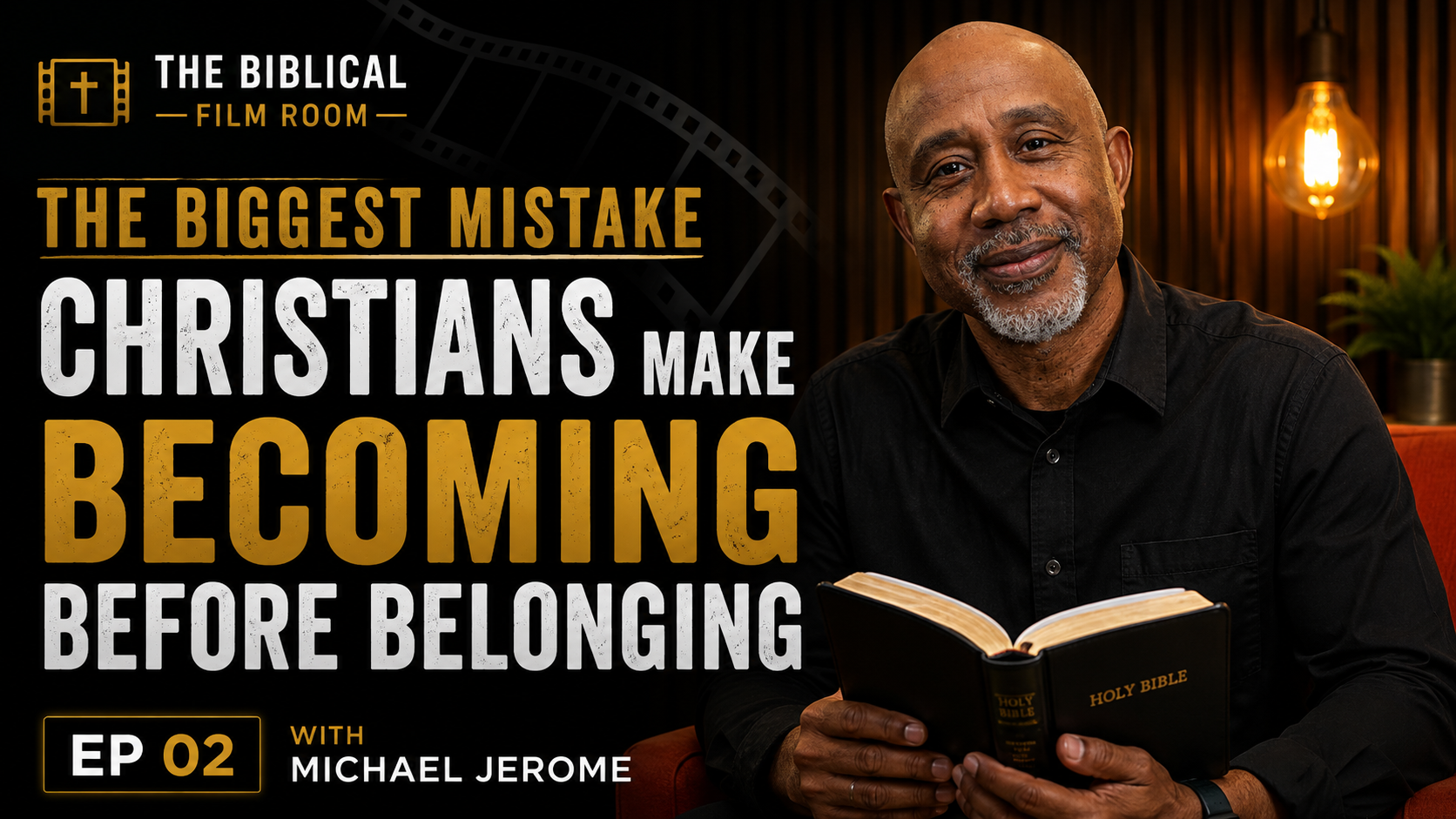
Ep 02 The Biggest Mistake Christians Make Becoming Before Belonging
Stop Striving: Why Belonging to God Always Comes Before Becoming
The Trap of Performance-Based Religion
Can I ask you a question? Have you ever felt like no matter how much you prayed, no matter how faithfully you served, or no matter how often you showed up at church, it still wasn't enough?
Have you ever felt that? Maybe you've thought, if I just can become a better husband, or if I can become a better wife, if I served more, if I knew more scripture, if I volunteered more, then maybe, I mean, just maybe, I'll finally feel close to God and be accepted.
Here's what I've learned. Many Christians spend their lives trying to become someone God already says they are. That was me. I confused doing with being, performance with belonging, and religion with relationship.
It nearly cost me everything. Because you can't become what you're trying to earn. You become when you accept the fact you have already been invited to belong.
Identity Before Assignment: Lessons from Genesis
Welcome back to the Biblical Film Room, a place where we slow down, reflect, and let Scripture examine our lives so we can grow in truth, walk in freedom, and live out our identity in Christ. This is Michael Jerome, your host. I'm excited to be here with you today.
Thank you for being with us as we continue this conversation, this story around how experiencing the new requires shedding the old. Gotta shed the old to experience the new.
Before we get into the show, did you know that I offer a complimentary 30-minute virtual discovery call? We'll talk about your story, where you feel stuck, and whether biblical counseling through a space of grace is the right next step for you. You can find the scheduling link in the show notes.
Now back to the show. Today we're stepping into the film room to examine one of the biggest spiritual mistakes I've ever made, and one I see hurting people make every single day. I was striving to become without establishing a sense of belonging.
We were created to belong before we were asked to do anything. Today I'm going to show you why and how that truth can transform how you live out the rest of your days. Yes, seriously.
We're going to start by looking at a scripture in Genesis 1:26 and 27 from the very beginning. Then God said, "Let us make mankind in our image, in our likeness, so that they may rule over the fish in the sea and the birds in the sky, over the livestock and all the wild animals, and over the creatures that move along the ground."
So God created mankind in his own image. In the image of God he created them, male and female he created them. And God blessed them and said to them, "Be fruitful and increase in number, fill the earth and subdue it, rule over the fish and the birds and the creatures."
Notice something remarkable. In the beginning, starting with Adam and Eve, before Adam worked, before Eve accomplished anything, before they messed up, before either one of them served, God called them his image bearers.
He created them in his likeness. Their identity preceded their assignment. The garden wasn't a performance review. It was a place where mankind could flourish out of a sense of secure identity.
Here's a film room takeaway for you: God never intended performance to establish identity. Identity was always meant to produce faithful living.
Some of you listening today have reversed God's order. I know I had for many, many years. You think: serve, become, belong. But scripture teaches: belong, become, serve. We were created to belong before we were asked to do.
The MVP Mindset: Playing from Confidence
So what does belonging actually look like in real life? What's that look like? Well first of all, I want to give a sports illustration. One of the things I love about sports is watching elite athletes.
If you've ever watched or follow a league MVP like in NFL, NBA, or Major League Baseball, you'll notice something. They don't spend the entire game or season trying to prove they deserve to be on the team. Do they?
They already know that they belong. You can see it. They're not wondering if the coach is going to cut them after every missed shot or every turnover or every bad play.
They play from confidence, not for confidence. They compete from identity and not for identity. That's why they can recover from mistakes. They know one bad play doesn't erase who they are.
Spiritually, a lot of you are doing the exact opposite. As I said before, this is what I did. Every prayer, every Bible study, every act of service becomes another attempt to prove you deserve a place on God's team. Or a place on some kind of ministry favor list.
I've seen something similar in counseling. People striving to do, to earn, to perform out of a desire to belong or be accepted or to be noticed.
Let me just plug in this observation from real life. A child who grows up in a healthy home where love isn't earned but consistently experienced often develops a secure sense of identity into adulthood.
They don't have to spend their lives asking: Am I enough? Will someone choose me? Do I have to perform to be loved? That secure foundation often helps them build healthier relationships and recognize when something is unhealthy.
Naming the Story: My Journey through Fear and Performance
But many of you, a lot of you, didn't experience that. You learned that acceptance came through performance—being the good kid, getting the good grades, avoiding mistakes, and people pleasing.
You unknowingly carry that pattern into your relationship with God. Yeah, that was my story. That was my story completely. As I look back, I can see I was searching for belonging long before my marriage fell apart.
First, I looked for it in my family of origin. Then I coveted and longed for it in church ministry. Finally, I desperately fought for it and demanded it in some ways in marriage.
So my story has a name: How I chase belonging through performance. Your story likely has a name as well. Now when I share my story, it is not about feeling sorry for me.
I am simply painting a picture you might identify with. I'm also not shaming and I'm not blaming anyone. I'm simply naming. Naming your pain from your perspective is very important.
It's something I tell my clients all the time. I'm going to be hopefully uncomfortably vulnerable here. I hope you can handle brutal honesty with me telling my story without sugarcoating it.
In my family growing up, I learned early on that doing the right thing brought safety, peace, and affirmation. I wanted to be a good kid so I could feel accepted and not get my butt whipped or be humiliated by standing in a corner on one leg for thirty minutes.
I remember my brothers and I sitting on the couch in complete stillness after we looked out the window and saw Dad's car arriving home. Dad's mood controlled the entire home.
It was literally like a thermostat. If he was good, the entire home atmosphere was good. But if he was angry, unhappy, or intoxicated, then the atmosphere was scary and uncomfortable.
Discipline was harsh on the regular. I didn't feel safe in the home for much of my early childhood years. As I got older, I was very insecure around everyone, particularly around females.
I essentially felt unliked if I wasn't like others, or as good as someone, or as attractive as others, or as smart as others. I feared being in trouble a lot growing up.
I did almost everything out of a sense of fear or appeasement. I didn't want to displease or disappoint my mom, and I definitely didn't want to do or say anything that would stir up my dad's wrath.
The one phrase that was attached to my identity that I constantly heard from my dad was that I was a "sorry ASS N-word." Me and my brother heard this a lot growing up in our adolescence years.
I don't believe my dad intended it for harm. It wasn't meant to break me down or make me timid. But that was the effect. I hated how timid, cowardly, and weak I was growing up through middle school.
I was picked on a lot by everybody. To compensate, I was an overachiever at school. I was a really good student and made really good grades. I was very obedient and quiet as a mouse.
I was like on point. I was always one of the best kids in the class and my teachers loved me. One of the biggest things I learned as I reflected on this was that I didn't know how to love my dad; I only knew how to fear him.
I had trouble really loving anyone unconditionally. It was more out of a fear of losing them or disappointing them or being harmed by them. Here's a takeaway from that experience: When love feels connected to performance, we carry that pattern into adulthood.
The Danger of Spiritual Activity without Intimacy
Which leads to my experience at church as an adult. At twenty-one years old, operating from that subconscious impact, I wasn't functioning like I was a child of God.
I was a prime candidate for what would transpire over the next 30 years, which was a lot of spiritual abuse. In the fall of 1980, I came into this church.
Some things were really good, like being devoted to the Bible, but there was a lot of stuff that was not good. I did all the right acts of service and was very compliant towards church leadership.
I was afraid to be my real self. I was afraid to disappoint. So I just went along with the program, even though some things were not good. It was a harsh, spiritually and emotionally abusive environment.
Spiritual bullying was the norm. It felt familiar in some ways; it felt like home. I was constantly told what to do, not asked or encouraged.
I would hear that voice telling me I was sorry, and I thought, man, this is kind of what I deserve. The temperature of the church environment felt similar to the home I grew up in with my dad.
I actually did love some aspects of church life, but this experience greatly tainted my view of God. I believed doing ministry meant being favored by God.
I thought the more I did, the closer I was becoming to God. But I was neglecting intimacy while pursuing activity. I knew how to work for God, but I didn't know how to be with Him.
I think that thought was scary. My experience with my dad affected my view of God. I saw God as a harsh father who was very begrudging when it came to showing love and kindness.
I worked very hard just to not get on His bad side. My lack of sense of belonging set me up to be exploited and controlled by this church organization. Again, I'm not blaming or shaming, but naming.
I unknowingly carried that same mindset into my marriage. Like I had done in my family and with my church, I placed my relationship with my spouse on a pedestal.
My quiet fear was: I don't want to disappoint her. I must earn her acceptance. If I can just become the right husband, if we served enough, if we stayed busy helping other people, everything would work.
But activity couldn't replace intimacy. Not with my spouse, not with Christ, and not with church members. I wasn't just trying to earn God's approval or the church's approval; I was trying to earn a sense of belonging I had been searching for my entire life.
What Real Belonging Looks Like
Here is the truth that I have discovered: there is a scripture in Matthew 22 where Jesus says, "You are in error because you do not know the scripture or the power of God."
Jesus doesn't say you don't work hard enough. He says you misunderstand God. I didn't know who God really was. I was too concerned with not disappointing him and fearing his wrath.
There was too much of an unhealthy fear that kept me from intimate relationship with him—this fear of going to hell or being punished. I did not really know scripture or the power of God in my life, even though I knew a lot of Bible verses.
Your story is likely way different from mine, yet you may have drawn similar conclusions. Like, man, God so loves the world, but does he really love me?
If so, why has all this stuff happened to me? The broken marriage, the stunned growth, the estrangement from family, the hiding, the fear of conflict, and the shame when I mess up.
That kind of thinking kept me walking in ignorance of the power and love of God. It kept me trapped for decades. I was so blinded by my fear of man and my people-pleasing paralysis that I didn't really experience God's affectionate care for me.
If you are stuck in a sin pattern, an unhealthy relationship, or a walk with Christ that is consistently up and down for decades, I will say you are in error because you do not know as you should.
You're trying to become, and you don't believe you belong. But my friend, you don't have to stay there. You can know Bible facts and volunteer every week and still believe your value comes from what you produce.
That is performance dressed in religious clothing, and it keeps you stuck. Relationship produces transformation; performance produces exhaustion.
Belonging isn't permission to remain immature or broken. Belonging is the secure foundation that makes transformation possible. Ephesians chapter one tells us you are blessed, loved, chosen, accepted, included, blameless, holy, and adopted.
You have redemption, grace, and forgiveness. Your inheritance is guaranteed. Children obey because they're already sons and daughters. They don't obey hoping to become family.
God doesn't invite you into his family because you've become impressive. He transforms you because you've become his.
It is time to set the record straight about our identity and our sense of belonging. The voice of shame screams that you are worthless.
God doesn't see you as a sorry, pathetic failure. I want you to name the names you've been called—idiot, crybaby, ugly—because you can't change what you won't name.
It is not about blaming a parent, teacher, or pastor. But you better name the story and the feeling from your perspective. I am living proof of this, and it almost killed me.
A Final Prayer for Identity
Today, we discovered we were created to belong before we were called to perform. Jesus calls us back to secure relationship and secure belonging.
Maybe you realize you spent years carrying a weight that God never asked you to carry. If that's you, I'm glad you're here. Because you belong.
I want to close up this episode with a locker room prayer over you. If you are able to, please bow as we pray.
"Father in heaven, thank you that we don't have to perform our way into your presence. We don't have to earn your love. We don't have to accomplish enough, serve enough, know enough, or become enough to prove that we belong. You loved us before we ever did anything for you. Thank you.
Lord, forgive us for the times we've confused doing for you with being with you. Forgive us for turning our faith into a performance, our churches into places where we try to prove ourselves, our marriages into places where we try to earn love, and even our relationship with you into something we think we have to accomplish.
Remind us that our identity comes before our activity—it always has. Teach us to live from belonging and not for belonging. For the person listening who has spent their whole life trying to prove their worth, Father, let them hear your voice saying, 'Son, daughter, you belong.'
For the person who has been hurt by the church, remind them that people may fail them, but you do not abandon your children. For the person who has been looking for belonging in a relationship, remind them that another person was never meant to carry the weight of defining their worth.
And for those of us who have spent years trying to become somebody, teach us to rest in who you have already called us to be. Father, help us stop playing the game for approval and start living from the confidence that we already have a place on your team.
Give us the courage to examine the tape of our lives honestly. Show us where we've been performing instead of abiding, where we've been proving instead of trusting, and where we've been becoming instead of belonging. And teach us that true transformation doesn't begin with trying harder. It begins with knowing you. We belong to you. Now teach us how to become the people you've called us to be. In Jesus' name, amen."
Film room, take that prayer with you this week. You don't have to prove that you belong. You get to live from the truth that in Christ, you already do.
Performance isn't the answer. Trying harder isn't the answer. Becoming more religious isn't the answer. You become because you've already been invited to belong.
Next time, I'm going to walk you through the framework that completely changed how I understand spiritual growth. It's the same framework that reshaped my faith after one of the darkest seasons of my life.
Hit that subscribe button so that you don't miss our next episode. Please drop a comment in the chat; I would love to hear from you.
Do a friend a favor and share the podcast. It just might change someone's trajectory. Thanks for joining me today. I'll see you next time in the biblical film room where God's word becomes the replay that changes your life.
Until then, watch the film, renew your mind, and live the truth. Godspeed. We'll see you soon.
Click in the link to see the full episode

Episode 10: What You Believe About Change Will Change How You Live-Part 2